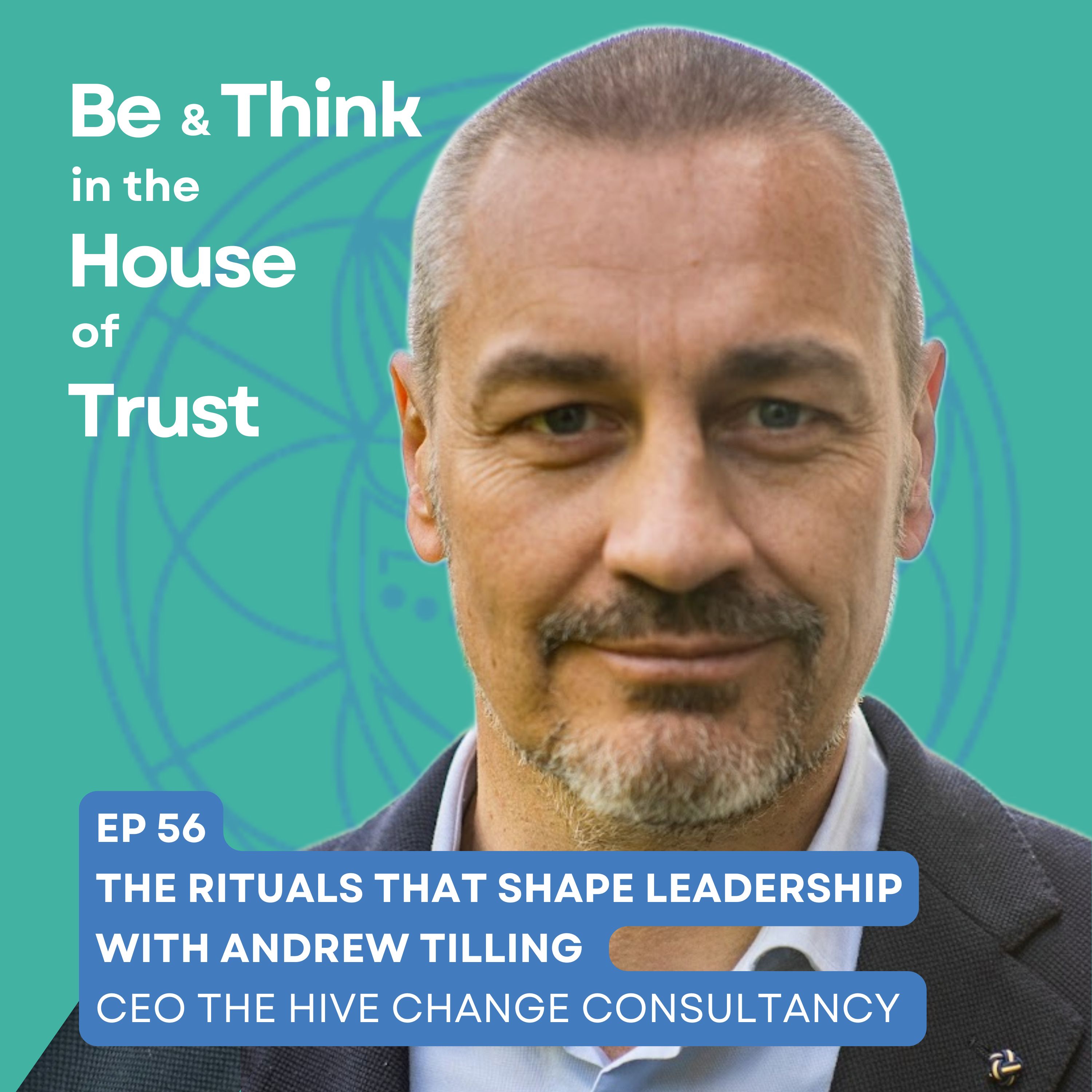

The Rituals that Shape Leadership, with Andrew Tilling, The Hive Change Consultancy
In this episode of Be & Think in the House of Trust, Servane is sitting with Andrew Tilling, CEO of the Hive Change Consultancy, a global leadership transformation and change catalyst. Andrew has moved through youth work, theatre, social enterprise, and Capoeira — and somewhere in that movement, he discovered something about stillness.
In this conversation, he shares how rituals of connection — small, intentional, repeatable — can quietly transform the texture of a team.
How circle time can do what a strategy document cannot. How empathy arrives sideways, through story and shared breath, when you stop trying to extract it.
We also wander into what it really takes to shift a culture, and why the body often knows before the mind catches up.
Come and listen. Slowly.
Some themes in this show:
- Finding Space in Movement
- The Art of Leadership
- Empathy and Perspective
- Rituals for Connection
***
Connect with Andrew:
The Hive Change Consultancy https://consultthehive.com/
LinkedIn: https://www.linkedin.com/in/andrewtilling/
Podcast Music Production from Ep 45: Milig Mouazan-Strachan
Connect with Servane:
LinkedIn: https://www.linkedin.com/in/servanemouazan/
Website: https://servanemouazan.co.uk
Subscribe to Conscious Innovation updates:
http://eepurl.com/hp0h55
Podcast Music Production from Series 04 Ep 45: Milig Mouazan-Strachan
Transcript
>> Servane Mouazan: Welcome. My name is Servane and I'll be your host
Speaker:and thinking partner today on this new Be and
Speaker:Think in the House of Trust podcast episode. My
Speaker:guest today has delivered award winning youth
Speaker:work. He's been an actor, he supported social
Speaker:enterprise. That's how we met many moons ago.
Speaker:Here's some fundraising for charities, also
Speaker:consulting for big business. And he travels the
Speaker:world and today I'm so happy to catch him. Between
Speaker:peregrination around the Big Wall of China and all
Speaker:these faraway countries, he's very committed to
Speaker:making a positive impact. And there's one thing to
Speaker:remember about him, that's that.
Speaker:So I'm welcoming Andrew Tilling. He's the founder
Speaker:and CEO of the Hive Change consultancy. He helps
Speaker:people to deliver culture change and he works with
Speaker:organisation whose work is too important to fail.
Speaker:He's an Ironman triathlete in training. We'll see
Speaker:how far he went with that. And he's also a
Speaker:Capoeira professor and he teaches in Italy. Andrew
Speaker:Tilling. I'm curious to think with him about
Speaker:empathy, connection and rituals that make team
Speaker:relationships flourish. Hi Andrew. We're so
Speaker:pleased to have you in the House of Trust.
Speaker:>> Andrew Tilling: You make it sound like such a very full life. It's
Speaker:a wonder I get any time to stop and think at all,
Speaker:really.
Speaker:>> Servane Mouazan: Do you?
Speaker:>> Andrew Tilling: I, deliberately do take the time and I think, you
Speaker:know, taking those moments when you are in. In
Speaker:movement and travel becomes really important. I
Speaker:mean, when I get home, I tend to want to fill it
Speaker:with time with my daughter and, and my wife and,
Speaker:and and the capoeira and everything else as well,
Speaker:so. But life's a journey, huh? Huh? A very full
Speaker:one if you can.
Speaker:>> Servane Mouazan: So Andrew, welcome. And as we're both Capoeira
Speaker:players, we both know that a bit of warm up before
Speaker:a game helps us to feel alive and present and also
Speaker:free of backache accessorily.
Speaker:>> Andrew Tilling: Which, which are more and more aches and pains
Speaker:that I bring into every class. Well, they tend to
Speaker:fade. They go, they go. But that warm up is
Speaker:essential.
Speaker:>> Servane Mouazan: So as a, as a warm up which. And as you as I can
Speaker:catch you sitting right now, what are you seeing
Speaker:from the place you're calling from right now that
Speaker:helps release tensions and turbulences?
Speaker:>> Andrew Tilling: Well, there's 300 olive trees to my right, which
Speaker:I'm with my, my in laws place down in Tuscany. So
Speaker:we've got. We've got a few hills and mountains out
Speaker:there, which is my view and my point to refle you
Speaker:Know the house around me. Ah, there's a little
Speaker:painting up there painted by my wife's aunt, who
Speaker:has got a wonderful eye for. For nature and for
Speaker:colour. A, relatively cramped desk. I could do
Speaker:better at tidying it up. you know, sometimes you
Speaker:just dump the bag, plug in the laptop and get on
Speaker:with the day, don't you?
Speaker:>> Servane Mouazan: So there's a lovely theatre scene around you here.
Speaker:I mean, just quite striking views and lovely
Speaker:emotional bonding, connection.
Speaker:>> Andrew Tilling: I think nature is essential, I really do. It's
Speaker:something that's always been very important to me.
Speaker:I remember when, Katharina, she'd found capoeira
Speaker:as being her thing. We started it together and we,
Speaker:you know, we had some fun with it and it was all
Speaker:good. but, there was a spark that lit in Katarina,
Speaker:that was just unquenchable. It was extraordinary.
Speaker:And she decided to start training up in London and
Speaker:we were living in Farnham in Surrey. She had some
Speaker:work up in London as well. So I was dropping her
Speaker:off at the station at 6.30am She M. Would then go
Speaker:off to work and then be there all day, then go to
Speaker:Capoeira and I would pick her up at the station at
Speaker:midnight. And this was just like every day. And I
Speaker:just thought, this is crazy. One, I'm only getting
Speaker:up there once, maybe twice a week and she's there,
Speaker:so that's not fair. I want more, you know. And it
Speaker:was just, unsustainable. so we moved to. The
Speaker:compromise was I didn't want to move to London,
Speaker:but Anne Katarina did. But we needed that travel.
Speaker:So we ended up in Kew, which is still technically
Speaker:Surrey, but it's got Kew Gardens right in front of
Speaker:the apartment. So we had a battered up apartment
Speaker:looking at very nice houses, but also then Kew
Speaker:Gardens as well. And that became a point where I
Speaker:think I probably managed to reorganise my brain to
Speaker:understand a little bit more about the corporate
Speaker:world and what I could bring to it. I think it was
Speaker:really during that time and, the social enterprise
Speaker:world, of course. I think I'll probably met you
Speaker:around that time as well.
Speaker:>> Servane Mouazan: Yeah, yeah, you mentioned London. Social
Speaker:enterprise, corporate world. But before that there
Speaker:was theatre, right?
Speaker:>> Andrew Tilling: Yes. And my mum ran a theatre school and, my
Speaker:father was involved in various different social
Speaker:projects. There was a lot of crossover there. We
Speaker:provided support for, the local community and for
Speaker:young people with special needs. And we had
Speaker:various different classes and I kind of grew up in
Speaker:that environment, which was, Very full and
Speaker:fulfilling and it gave me an opportunity to
Speaker:explore leadership without really recognising that
Speaker:I was leading. Because in my mind, when I was a
Speaker:kid, you know, being a leader was being the boss
Speaker:or the captain of a. Of a sports team or
Speaker:something. Right? But, I never really counted
Speaker:writing a school play, directing it and taking it
Speaker:on tour around feeder primary schools as
Speaker:leadership. That was just me doing my thing.
Speaker:Right? and my, My mother's theatre school, you
Speaker:know, I was teaching there and, and directing and
Speaker:writing shows and so. And again, that, in my mind,
Speaker:that wasn't leadership, that was just getting on
Speaker:with the art and everybody taking a job and
Speaker:whoever's best for the job just get on and do that
Speaker:job. You know, that's kind of the way that I
Speaker:viewed the world. I ended up working in. In
Speaker:Guildford, in Surrey and had a youth theatre
Speaker:there, which, with the youth team and the
Speaker:extraordinarily inspiring, Julia Burgess, who,
Speaker:just taught me everything about positive
Speaker:reinforcement and creating a healthy space and all
Speaker:these. These wonderful things. And we managed to
Speaker:grow that youth theatre to about 400 students.
Speaker:And. And that's where we did some work with the
Speaker:High Sheriff of Surrey's, funding team and. And
Speaker:were able to do some work around crime prevention,
Speaker:using theatre as a. As a tool, which is what ended
Speaker:up winning the awards. But, again, for me it
Speaker:wasn't leadership. It was just this, you know,
Speaker:contributing to the community, creating space,
Speaker:allowing things to happen, you know, trying to
Speaker:help people find what they could contribute and,
Speaker:And creating space for that and seeing that grow
Speaker:and evolve. And it, It kind of took me to a place
Speaker:where, you know, I kind of fell out of love of the
Speaker:professional acting. It was there, you know, I'd
Speaker:get jobs every now and again. Technically, I was a
Speaker:professional actor for seven years and working
Speaker:consistently through that. But I just. It just. I
Speaker:realised it wasn't my focus and it wasn't bringing
Speaker:me joy. And what was really bringing me joy was
Speaker:that youth work. So.
Speaker:But I kind of fell out of love with the, With the
Speaker:profession, not the art. And so I wanted to find
Speaker:some way of connecting and continuing that work
Speaker:around developing people and using those skills.
Speaker:But I knew I needed to step away from that, from
Speaker:that theatre world. And I. One of my students, Guy
Speaker:called Rob, just come back from walking the. The
Speaker:Norwegian fjords and he's. At 16 years old, he was
Speaker:just very resilient kid. Came, back with a lonely
Speaker:planet of India and said, look, I think what
Speaker:you're looking for is probably there. And so I did
Speaker:a drama course, charge some money for it, got
Speaker:about three and a half grand from it and that was
Speaker:enough to live in India for a year. And I went,
Speaker:that was it, one way ticket, go and explore. And I
Speaker:opened that Lonely Planet on the plane, right? It
Speaker:was like, okay, where am I going?
Speaker:>> Servane Mouazan: You know, which was perhaps you're such a good
Speaker:planner.
Speaker:>> Andrew Tilling: Ah, ridiculous. I thought, you know, I'll live in
Speaker:the moment, don't ever do that. You know, what
Speaker:happens is you get redirected because it's
Speaker:September 13th and September 11th just happened,
Speaker:right? All, everything was a disaster. Baggage was
Speaker:getting lost. I left for India with a purple
Speaker:plastic carrier bag. That's all I had. My baggage
Speaker:had been lost on another plane. It was some things
Speaker:that, it was like a money belt, you know, maybe,
Speaker:you know, a few bits like that. I had no keys, I
Speaker:owned nothing. But fortunately my bag was found.
Speaker:But I going to pick up that bag meant that I
Speaker:missed my flight. And I got redirected to, to
Speaker:Mumbai. And I spent my first night in India
Speaker:walking onto, Chapati beach, having some armed
Speaker:guards point their weapons at me saying, the beach
Speaker:is closed. I'm like, oh my God. So walking along
Speaker:the street, I've got guys coming out saying, you
Speaker:want jiggy Jiggy? I'm like, oh my gosh. I'm just
Speaker:like. So I ended up going into a manager, I've got
Speaker:a spare bed in a manager's office and of a hotel
Speaker:and, and kind of hid like that for my first day.
Speaker:What have I done? You know, my life is all over.
Speaker:So, but from there I flicked through that book and
Speaker:I saw a picture of the Dalai Lama. And I thought,
Speaker:he looks like a friendly chap. I'm going to head
Speaker:up to Dhalamsala. Cleo Ganj and I went up there
Speaker:and I, I met dear friends who've remained friends
Speaker:for life. I found a space, I found a way of
Speaker:thinking, I found a, something I feel like a
Speaker:methodology or a mindset that allowed me to lean
Speaker:into so much of what had remained hidden in my
Speaker:life, which was my sensitivity, my high
Speaker:sensitivity, have empathy dialled up to about 11
Speaker:all the time. So I kind of tend to feel what's
Speaker:going on around me and other people's feelings.
Speaker:And that was, that was a very confusing time for
Speaker:me. But then I kind of began to understand, ah,
Speaker:it's not just me. This is not all my feelings.
Speaker:These Are other people's feelings, what am I
Speaker:feeling? And I kind of was able to use this
Speaker:meditation and these tools and these techniques
Speaker:to, to find yeah, place, I guess an internal house
Speaker:of trust. A place where I could feel settled and
Speaker:secure and non performative and more receptive.
Speaker:And from there I began to understand that you
Speaker:know, what all these expectations that other
Speaker:people had on me to, to be the great actor or to
Speaker:go and be successful in these areas or to take on
Speaker:these different roles, in fact they would. It was
Speaker:me trying to please other people or satisfy other
Speaker:people's expectations and, and from there I was
Speaker:able to kind of let go of the whole theatre thing
Speaker:and all the, this sense of oh, am I going to be a
Speaker:failure if I step away and really start connecting
Speaker:with what I came to understand as leadership and
Speaker:positive impact and creating environments and
Speaker:communities and systems that lead to breakthroughs
Speaker:and healthier environments where people can
Speaker:thrive.
Speaker:>> Servane Mouazan: So that's interesting because you tell us the
Speaker:inner workings of change here, what happened and
Speaker:how you found your inner house of trust and you
Speaker:didn't have to perform for others but find
Speaker:alignment within. I wonder when you come to these
Speaker:places now, you travel the world, you help people,
Speaker:you know, becoming connected with themselves, move
Speaker:as entities, as teams to, to reach their
Speaker:objectives and do good stuff. When you come in a
Speaker:room with this story within that people don't
Speaker:know, how do you, how do you help people be aware
Speaker:of the fact that you're not going to present them
Speaker:with a case of performance stuff like that, but
Speaker:you have another story to tell. How do you set the
Speaker:tone?
Speaker:>> Andrew Tilling: You know, I was in Qingdao in China just last week
Speaker:working with a group of very senior leaders,
Speaker:undergoing a, a shift in strategy. They're moving
Speaker:from an equipment based mindset, in other words,
Speaker:produce a product and make it good, sell it and go
Speaker:to a service based mindset which is we are going
Speaker:to be responsible for the uptime and the, and the
Speaker:success of our product within your, within your
Speaker:system. And it basically means rewiring the whole
Speaker:organisation, how they think, how they work, how
Speaker:they collaborate. And it's one of the biggest
Speaker:challenges that organisations face is shifting
Speaker:from this place where we have very clear vertical
Speaker:lines of alignment at the top and then clear
Speaker:communication and accountability down through the
Speaker:vertical to shifting decision making further down
Speaker:those lines and creating the network and the
Speaker:interconnectivity required to ensure collaboration
Speaker:across departments so they can work as one across
Speaker:a range of different challenges. it's absolutely
Speaker:rewiring the whole fabric of how that organisation
Speaker:works. And there's research that's been done that
Speaker:says that managers of teams trust their team and
Speaker:their boss to perform, to deliver something like
Speaker:87% of the time. We've got extraordinary
Speaker:capabilities and skills vertically, but only 9% of
Speaker:managers trust managers and teams at other
Speaker:departments to deliver all the time. 9%. And that
Speaker:gets, you know, I think, really heightened in
Speaker:states of change and complexity because our stress
Speaker:responses are all up there. You know, we're all on
Speaker:defence. You know, it all becomes really hard.
Speaker:>> Servane Mouazan: Keep it inside in my house, right? The one I don't
Speaker:want to share. Yeah.
Speaker:>> Andrew Tilling: So I think coming in with that kind of clarity
Speaker:within an environment with these leaders and,
Speaker:making it really clear what's at stake for their
Speaker:business if they're not able to address some of
Speaker:these ways of working and let go of control and
Speaker:all this kind of shift. We're talking about
Speaker:significant mindset shift right from the very,
Speaker:very top. Coming in with that clarity, but then
Speaker:being able to talk about and share it. Sometimes
Speaker:it's a bit of a drip feed. You know, I start with
Speaker:my credibility and credentials of the work that
Speaker:we've worked and then I might start opening up and
Speaker:let's slip that I was an actor once, you know, we
Speaker:open it, right? it's happened to me before. I've
Speaker:had. I've had feedback saying, look, you know,
Speaker:people like your content, but they don't think
Speaker:they should listen to you. Andrew, you know, what.
Speaker:What's going on? It's like, you start with a story
Speaker:about being an actor and it's like, where's your
Speaker:credibility? And I realised I was introducing all
Speaker:these other people that I was working with and
Speaker:putting them on this pedestal, but nobody was
Speaker:introducing me as the leader of the programme or
Speaker:whatever. And I was coming as. I'm just this actor
Speaker:fella, you know, So, I mean, I'm very clear and
Speaker:upfront from the start that, I've had the
Speaker:opportunity to lead transformation. I've been led
Speaker:a transformation that led to a doubling of results
Speaker:that raised £27 million for charity. I've helped
Speaker:organisations rewire and have this big impact upon
Speaker:their bottom line. Get that out the way.
Speaker:>> Servane Mouazan: The business card that people need to stop and
Speaker:listen to you and then you can start the work.
Speaker:>> Andrew Tilling: It's got to be there. I mean, you. You said it
Speaker:right from the very start. I mean, I. I was able
Speaker:to, you know, sit and talk about travelling and
Speaker:presence because, you You've. You've opened up
Speaker:this by talking about the, you know, the range of
Speaker:experience and the story that I've had, you know,
Speaker:but that doesn't always come. And I think being
Speaker:clear, you know, if you want to establish trust
Speaker:people, you need to make it clear the value that
Speaker:you bring in any situation, you know, And I think
Speaker:if you can, it's not about boasting. I think a lot
Speaker:of people kind of their egos get in the way of not
Speaker:wanting to come across as being egotistical. It's
Speaker:like, well, that's one side. You know, show people
Speaker:what's on offer. Hm? That you want that, you know,
Speaker:what, how you can make that impact, how you can
Speaker:contribute. And I think once that's clear, then
Speaker:you can start that journey of interaction. But
Speaker:then. So, yeah, I think from that point on, it's
Speaker:like recognising that they need to go through
Speaker:significant change. But I've had to go through
Speaker:that change on a personal level. I've had to lead
Speaker:teams through that change. I've had to lead
Speaker:organisations through that change. And if you can
Speaker:sit in that space of recognising that change is a
Speaker:constant. We live in perma change, you know, we're
Speaker:in ever, ever constant flux. If you can create
Speaker:that space to, to kind of frame the challenge,
Speaker:recognise that it's challenging, but show that. Do
Speaker:you know what, You've walked some of these paths
Speaker:before and you're happy to contribute to that
Speaker:journey, then I think people take that step back
Speaker:and say, okay, look, I've got a guide. And one way
Speaker:I like to frame it is that, you know, I. I don't
Speaker:know, I put up a picture of the Great Wall. I
Speaker:meant I saw the Great Wall of China for the, for
Speaker:the first time. It was amazing. You know, last
Speaker:week it was in Beijing. But I got a shot of me up
Speaker:on this Great Wall.
Speaker:>> Servane Mouazan: Yeah.
Speaker:>> Andrew Tilling: And I, put that as my opening slide. It's like,
Speaker:look, this is where I was last week and this is
Speaker:what I was doing. And then I was. But I was able
Speaker:to talk about, how, they used to light these
Speaker:plumes of smoke to communicate how many armies
Speaker:were attacking them. And these plumes of smoke
Speaker:would go through each tower and they were able to
Speaker:communicate across thousands of kilometres. Yeah.
Speaker:Using this method of just lighting file and
Speaker:putting flames of smoke up. So kind of tied in, in
Speaker:a metaphor there. But it says, look, I'm. I'm
Speaker:here, I'm a. I'm. I'm a tourist, I'M part of this.
Speaker:But, you know, you might look at this and think
Speaker:you know everything already about the Great Wall
Speaker:of China because, you know, you live here and, But
Speaker:I'm, I'm not here to be the local guide. You're
Speaker:the local guide. You've got your local expertise,
Speaker:all of you owning different areas of the business.
Speaker:You, you know all about your environment. My job
Speaker:is to kind of share the big story the big picture.
Speaker:But each of your points of views, each of your
Speaker:expertise, of your perspective is going to be
Speaker:vital if we're all going to be able to navigate
Speaker:this effectively together. It's multi
Speaker:perspectivity and systems thinking. You need that
Speaker:sense of understanding of the part of the elephant
Speaker:that somebody else is looking at and how that's
Speaker:different to your own to reference that story
Speaker:classic story of, you know, somebody thinks the
Speaker:elephant's a bit like a tree trunk and somebody
Speaker:thinks it's like a snake. You know, they're all
Speaker:holding different parts of the elephant.
Speaker:>> Servane Mouazan: Yeah.
Speaker:>> Andrew Tilling: But if, you know, if we can bring in a sense of
Speaker:empathy for other people's perspectives and let go
Speaker:of our need to be right and our need to convince
Speaker:other people that our point of view is the right
Speaker:one. If you can unlock that in groups,
Speaker:particularly at the leadership level, it's
Speaker:extraordinary how fast change can take place. It's
Speaker:extraordinary how open people become to change
Speaker:because they recognise that their picture is more
Speaker:than they thought was real. They're part of
Speaker:something bigger. And when you're part of
Speaker:something bigger, you're out of ego, you're in a
Speaker:sense of purpose, you're in a sense of shared
Speaker:understanding and clarity. Everything begins to
Speaker:move.
Speaker:>> Servane Mouazan: You just describe systems thinking like a meadow,
Speaker:not a linear, siloed, parcelized, separated, dry
Speaker:thing. And you did it in such a little amount of
Speaker:time, which was lovely.
Speaker:>> Andrew Tilling: I had no idea when I started teaching systems
Speaker:thinking, it was like, oh, that's what they're
Speaker:calling it, you know.
Speaker:>> Servane Mouazan: Yeah, yeah.
Speaker:Ah, but the words are a bit boring. When you tell
Speaker:the story of, what you just told, suddenly it
Speaker:touches us. Right. How people are interconnected.
Speaker:Yeah. The bigger picture, the smaller picture, the
Speaker:local guide, the storeys, the context and how they
Speaker:are all talking with each other. Like the smoke
Speaker:from tower to tower on the big wall, conveying a
Speaker:message. They're all interdependent. I, picked up
Speaker:a few rituals here, creating this space, bringing
Speaker:some empathy touch points here.
Speaker:What are other rituals or micro moments that you
Speaker:rely on or you invite people to rely on? When they
Speaker:are on that journey of leadership.
Speaker:>> Andrew Tilling: It started that, that training at the stage with a
Speaker:big slide behind me, you know, this audience in
Speaker:front. By the end we were in circles, so always
Speaker:coming back to circles. You know, in theatre,
Speaker:remember we had this, we would always start with
Speaker:circle time. It was like, you know, everybody
Speaker:would kind of cheque in, if you like, people call
Speaker:it checking in nowadays. It's, you know, back then
Speaker:it was just having a chance to just feel
Speaker:everybody, I guess, get that sense of where
Speaker:everybody's at, understand who's in the room and
Speaker:how we're showing up. And you know, I'd ask this
Speaker:question, how was your weekend? Or what did you do
Speaker:this weekend? Or something else. M. But I remember
Speaker:I was working with a group of children with, with
Speaker:various degrees of disability.
Speaker:>> Andrew Tilling: and one of, one of these children, a girl called
Speaker:Zoe, she had down syndrome. And we would, would go
Speaker:around the circle every day and it would, every
Speaker:Saturday rather, and it would come to, to her and
Speaker:would say, okay, so what did you do this week? And
Speaker:there'd be silence. Okay. But we gave her a time.
Speaker:And I was, I was pretty consistent in making sure
Speaker:that she had her time. But then one day I thought,
Speaker:no, I'm going to give her time. And I said, you
Speaker:know, we went around and everybody said, what did
Speaker:you do this week? And it must have been about 90
Speaker:seconds, two minutes, it felt like an hour. But
Speaker:she just suddenly took this breath and went, well,
Speaker:this week we went to my grandmother's house. Not
Speaker:grandmother's house. There was Casualty on TV and
Speaker:on Casualty there was a doctor and the doctor was
Speaker:saving a patient who'd been in a car accident and
Speaker:the girl had had this problem and such and such.
Speaker:And then we went to the park. In the park there
Speaker:was a dog and the doctor, what did you do this
Speaker:week? Is a huge question. It's massive. And to
Speaker:allow her brain to try to pull all that experience
Speaker:together takes time. But I don't think anybody was
Speaker:really giving her any time. So creating that
Speaker:circle and giving people space and time to
Speaker:reflect, I mean, even in China with these senior
Speaker:leaders, I'd say this is the question I'm going to
Speaker:be asking you in three minutes. Give them time to
Speaker:reflect and to organise their thinking and then
Speaker:translate that into a second language and be ready
Speaker:to present it to the room. You know, giving people
Speaker:time becomes essential. Or you just drive through
Speaker:and you think you've got to fill the space. I
Speaker:think it's a Big problem with leadership. So we
Speaker:come on in thinking we've got to fill the space.
Speaker:It's that performative. What we're trying to do is
Speaker:stimulate response. Just in every system we're
Speaker:simulating response in order to learn from the
Speaker:feedback and then that feedback can become a
Speaker:virtuous loop and we're able to contribute and add
Speaker:value in a way which, which resonates better with
Speaker:the system. So again, creating these circles where
Speaker:we can feed back and hear and sense each other
Speaker:becomes an essential part of the game. But I mean,
Speaker:since stepping away from theatre, I find that in
Speaker:capoeira every week whenever I get this urge, I've
Speaker:got to go and be in a show. Ah, you know, I must
Speaker:go and perform something. I'll go to, I'll go to
Speaker:capoeira and one roda and I'm done. I'm good, I'm
Speaker:fine. It's just, it's like it just resets
Speaker:everything, you know, you know that feeling.
Speaker:>> Servane Mouazan: Oh, good. Yeah. Memories are floating in now and I
Speaker:won't even have the time to think about them,
Speaker:before we end this episode. But what I've ah,
Speaker:taken away here is that, ah, creating a, shape. It
Speaker:can be a circle for you and I and many other
Speaker:people, but shape where people can see each other,
Speaker:can recognise, acknowledge each other, giving them
Speaker:the time to think, uninterrupted time to think.
Speaker:All these storeys to come up, make sense in their
Speaker:own time and for people to bond and connect and,
Speaker:and be aware that they're part of that meadow. I'm
Speaker:a bit moved here. Thank you so much.
Speaker:>> Andrew Tilling: I can just end it on one one thought that is this
Speaker:even in my capoeira teaching and I'm working with
Speaker:the. These senior students really developing their
Speaker:game and they're working with beginners, you know.
Speaker:And the wonderful thing about Kapua is that we can
Speaker:exchange no matter on our. What our skill level
Speaker:is. Yeah, but one of my favourite classes to teach
Speaker:is that, you know, when you deliver a kick, you
Speaker:may find that the beginner hasn't left or even
Speaker:student hasn't, hasn't escaped that kick yet. Slow
Speaker:down the kick and stop and just give them time to,
Speaker:for their body to find and escave a way to escape.
Speaker:And the more that we do that for each other and
Speaker:create that moment, look, here's the, here's the
Speaker:stimulation. Find time to respond. What happens is
Speaker:that the other player becomes stronger, more
Speaker:creative in their exploration of their own game,
Speaker:which contributes more for you. Which means that
Speaker:you can grow. And we've suddenly we've got a game,
Speaker:we've got a growth, we've got a harder, we've got
Speaker:stimulation, we've learning couple word is
Speaker:happening. We need to stimulate our teams, we need
Speaker:to stimulate our systems. We need to provide
Speaker:challenges but give people time to allow that
Speaker:creativity just to, to find its, its space, find
Speaker:its, its own. and I've consistently been surprised
Speaker:at the difference between that, you know, wanting
Speaker:that immediate reaction and just allowing space
Speaker:and time for the response to emerge.
Speaker:>> Servane Mouazan: well, that sounds like a beautiful invitation to
Speaker:share to people who are listening now. In the next
Speaker:30 days can space for the the response to grow and
Speaker:to find its way.
Speaker:Thank you so much, Andrew, again and for being
Speaker:here with us in the house of trust.
Speaker:>> Andrew Tilling: Thank you, Servane. It's always a pleasure to
Speaker:speak with you and thank you for the spaces that
Speaker:you create.
Speaker:>> Servane Mouazan: Well, thank you everyone for listening, for being
Speaker:with us today. This podcast is available
Speaker:everywhere, on all the channels that do podcasts,
Speaker:you know where they are. If you need more
Speaker:resources, information or thinking prompts, Space
Speaker:to Think will hop onto my website,
Speaker:sylvainmoisin.co.uk, you can also subscribe to the
Speaker:newsletter. it's packed with events and learning
Speaker:opportunities and it's all available also. And all
Speaker:the resources are available in the show notes. I
Speaker:see you soon. Thank you, Andrew. Thank you
Speaker:everyone. Take care of yourselves and each other.
Speaker:Bye bye.
Speaker:>> Andrew Tilling: Sam,